Showing posts with label Bible Characters. Show all posts

14 January 2014

The Father Of God


One of the greatest injustices of setting a day to represent the birth of Christ namely the 25th of December is that we have limited our celebration and reflection of it to that time of the year only. Most of us are guilty of remembering Christ’s birth as often as we remember our on – once a year. Honestly speaking, we only ever sing songs, listen to sermons and read and recount the story of Jesus’ birth at Christmas. I think that’s unfortunate because Christ’s birth was a milestone in the history of mankind. Bebo Norman, a contemporary Christian musician wrote:
And the angels filled the sky
All of heaven wondered why
Why the King would choose to be
Be a baby born to die
It seems the Lord’s Supper has ‘rescued’ the event of Christ’s death from such a fate. I am convinced that is why Jesus actually instituted it – “Do this in remembrance of me” he said.

In a bid to rebel against this unfortunate trend, I wish to reflect upon the oft overlooked role that one man played in the birth and life of Christ. His contribution is always mentioned at the very beginning of Christ’s earthly life but soon after that he is never mentioned again, neither by people who speak of Christ’s birth and life or even by the bible itself.

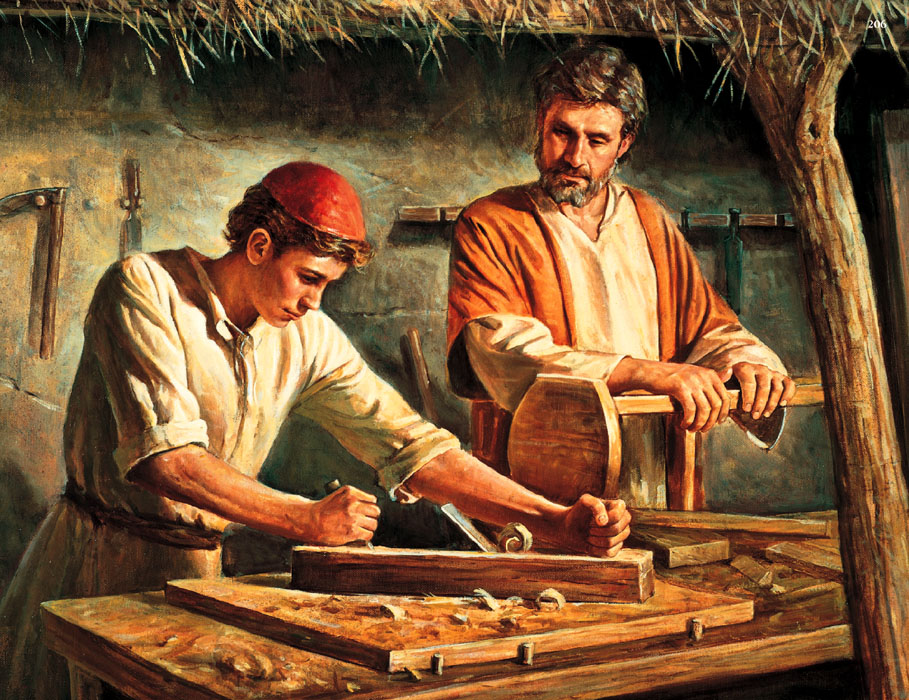
This man is of course, Joseph. There is some disagreement about Joseph. Some suppose he was a middle to older aged man. Some traditional writings further suggest that he had already been married and was widowed with several children. In fact, most image representations of him show him grey haired and bald. But early writers had a bias. In a bid to defend the virgin birth which was in doubt they may have been inclined to stretch facts and depict Joseph as very old and Mary as very young to discourage people from thinking that Jesus was conceived by their coming together out of wedlock.

We'll never know for sure how old Joseph was at Christ's birth while we're on earth. But I am more inclined to think that he was a younger man. I have a lot of respect for a young Joseph. I imagine a young Joseph to be focused rather than living life without any real intent. I imagine that he wanted to be successful and worked hard. I imagine that he, like any other young man, had plans. He certainly had his sights set on a young lady named Mary. He must have looked forward to marrying her and raising a family with her.

But life is no fairy tale and like many real life stories, things soon came crumbling down. For Joseph, it was when he found out that the young lady he loved had fallen pregnant. I bet he was devastated. But young Joseph was a good man and sincerely loved Mary so much so that he decided that rather than soothe his pain by battering her reputation, telling everyone how terrible and how lacking in chastity Mary was, he opted to quietly end his relationship with her instead.

I would imagine that a young Joseph soon picked himself up and begun to re-strategize but God had other plans. And this is where my respect for this man comes in.

I don’t think the average fellow who is just starting out with a promising career, already earning some good money and rising up all the ladders that this life has on offer would agree to father the child of his pregnant fiancĂ©e. A child changes things. That powerful car, nice house in a prime location, big wedding or great vacation all have to be put aside to not only ensure the safe arrival of the child but prepare for its future. A child means goodbye to a lot of the time you looked forward to having with your new wife. It means dirty diapers and late nights. It means missing out on late nights and weekends away with friends or special events you would otherwise have attended. The damning thing about it is that raising a child is a long term endeavour, at least 18 years and many times much longer. That is why the average teenage girl who tells her boyfriend that she has gotten pregnant, sees the man, younger or older, run in the opposite direction. Not many guys, especially still youthful, would consider such a sacrifice for their own child conceived out of wedlock but Joseph embraced it for a child conceived that was not even his own.

Joseph laid his hopes and dreams aside for a cause that was much bigger than him. I dare say he laid it aside for the greatest cause in mankind’s history – ever. God calls young men and women to do all sorts of things for him and many are willing until those callings begin to mess with their plans and comforts. And that’s why I am convinced that very few young men would agree to do what a young Joseph did because of how much it cost him. I’m not sure that I would.

Consider how it all ends. Joseph is not mentioned again after Christ’s 12th birthday. Sure it cost Mary a lot too but at least she gets mentioned during and even after Christ’s death. So prevalent was her role that she is worshipped thousands of years later in the Catholic Church. But for Joseph, it’s like he never existed. He certainly doesn’t exist in the pages of scripture after the first few chapters of the gospels that narrate Christ’s birth. After Bethlehem we all pretty much forget him. After all he sacrificed he is forgotten in the early pages of the story of Christ. Which man would sign up to lose so much and gain so little in the end? Sure, the title “the Father of God” has a ring to it, but when it comes down to it, there’s not much else there on this side of eternity.

I have no doubt though that Joseph will have many crowns for the humble, soon forgotten and life interrupting role he played in the grand story of redemption. Such sacrifice cannot go unnoticed by God in heaven. A man we may pity now on earth will be the envy of many in heaven. A young Joseph is a challenge to any young person with hopes and dreams and a promising future who God calls to take a road that ‘ruins’ all those things. How glorified and honoured God must feel when a man or woman makes such a sacrifice even though it costs them so much with so little earthly gain. I have a lot of respect for a young Joseph and I look forward to meeting him in heaven. He must have been quite a man!

04 September 2012

It's All Gone

Imagine for a second that you got a call from your doctor saying they found a deadly disease in your body from your last medical checkup. The disease is incurable and would result in high medical fees, a long life of visits to the hospital, huge dosages of drugs and pain for the rest of your life. Being the optimist you are you quickly thank God for your loving family who would stand by your side and of course the savings you have and were planning to spend but would now channel to your health. No sooner does the thought cross your mind than do you get another call while the doctor is still speaking to you, so thinking that no news could be worse, you thank your doctor and excuse yourself saying that you have another call and would come in to see him later. You quickly pick up the next call and it’s your banker. He says that your bank, where you keep all your money, has gone bankrupt due to internal fraudulent activities and that all your money is gone and cannot be replaced. Before you can respond or even process this information properly a knock comes at your door. Again thinking that nothing could ruin your day (and life) any further, you cut the call from your banker, before he can even finish, and get the door. It’s the police. The cop takes off his cap and holds it to his chest and tells you that your family is dead and they’d like you to go with them to identify the bodies. They died on the way home in a freak accident.

Overwhelmed with all this you suddenly feel weak and seat at the step of your door. The cop lays his hand on your shoulder. Within a minute you have lost your health, wealth and family. What would your reaction be?

Well, Job went thru a situation much worse. He not only lost his health, wealth and family, he lost everything else. The bible records that four servants came in quick succession, each bearing terrible news. Before each one could even finish delivering the news, the next arrived with more bad news. The first reported that his oxen was gone, the next that his sheep were gone, the third that his camels were gone, and the last that his children were all gone. And all his servants except the four (for he was a wealthy man) were also gone.

Job's reaction is, for me, astounding. It's mouth dropping and really the more I ponder it, the more it becomes one of my most favourite passages of scripture. The bible says Job bowed down and worshipped. Wow.

What a walk with God this man must have had! And what a challenge, to reach such a height in my relationship with God that even after he takes everything and strips me bare, I can bow down and worship. May it be so!

04 April 2012

The Meaning of Easter


Easter is celebrated the world over to commemorate the resurrection of our Lord. Some religious groups prefer not to call it Easter for reasons that I completely understand.

You see, the most widely accepted origin of Easter is taken from a 6th and 7th century scholar known as the father of English History. Whether the origin that he suggested was made up or true is not certain.

In one of his books he says that Easter was actually a month named after a goddess, a month which is our April equivalent. The feasts celebrated in the goddess’s honor in that month were forgotten with the passage of time and replaced with the celebration of Jesus’ resurrection as we know it today and this two or so centuries after Christ’s ascension.

This explains the apprehension that some have today with calling it 'Easter'.

Galatians 3 offers at least three things that Easter means to a Christian. It shows us that Jesus’ died to redeem us from a curse. That he did this to fulfill a promise He made to Father Abraham. And that He did all this out of no duty but rather by His grace.

Easter means that we are children of Abraham. God promised Abraham several things. The promise to Abraham that he would have as many children or offspring as the stars in the sky is particularly significant. That promise was God's way of opening the door for non-Jews like me and you. Paul tells us in Galatians that that promise facilitated Abraham’s spiritual children, children who did not fall in his genealogical line but children that live like Abraham-those who live by faith. Hence the song:
Father Abraham had many sons,
Many sons had father Abraham
I am one of them, and so are you
So let’s all praise the Lord!

Let me put it this way, when Abraham looks down on this earth and sees Jews who are his natural descendants and sees you who is not, he feels a much stronger attachment and connection, a stronger affinity and bond to you. And even though, you do not share blood, you do not fall in his ancestry, even though you look nothing like him, he recognizes you as his very own because you live like him, you live by faith!

And that was Jesus' point in John 8 when He told the Jews that if they held on to His teaching they would know the truth and be set free. "Free?" They asked, "We have never been slaves. We are children of Abraham." They treasured their ancestry you see. Verse 39 says,

"Abraham is our father," they answered. "If you were Abraham's children," said Jesus, "then you would do the things Abraham did." ~John 8:39.
You can almost picture Abraham watching down from heaven, jaw dropped, seeing the descendants of his beloved son Isaac reject the Son of God and turn his face away in disgust. Then he sees you and I accept Jesus, coming to Him empty handed, just as we are. We can almost hear Him echo Jesus' words, "My real children are those who live as I lived."


Those who have faith like Abraham are his real children and they are blessed along with Abraham. The opposite of a blessing is a curse. Easter means we are blessed. We are given salvation freely and escape the curse that anyone else that refuses this free gift are under, that of earning salvation by living a perfect life. It is a curse because no one can live a perfect life. Paul calls this redemption from the curse of the law saying that Jesus redeemed us from this curse by being cursed Himself.


Finally Easter means God’s grace. This comes out clearly in verse 18 of Galatians 3. God did not have to promise Abraham anything. He did it by his grace. He extended the blessing of redemption to you and I who are unnatural children of Abraham not because He had to but because of His grace. He chose that the way through which this promise would be extended to us be by Christ redeeming us from the curse of the law by becoming a curse for us not because He had to but because of His grace.

04 February 2012

The Good Samaritan


I read the story of the Good Samaritan in Luke 10:25-37 and find the Priest and Levite’s behavior a complete abomination. How could they walk passed a dying man like that? Well, I walked passed those that are in need around me every day.

The reality of the matter is that the easiest thing I can ever do is not get involved. It’s costly to help those in need. It takes time and it takes money. What would seem to be an active process, namely walking past a man lying on the ground motionless, is actually the easiest thing to do. What would seem natural and human, is in fact the very opposite. Getting involved is the real active process. And it’s a shame. It’s a shame that I don’t get involved.

We pass by the needy all the time: Those lunatics who stretch out their empty hands towards us at bus stops, the street kids we drive past on the roads, the blind men and women who sit on the corridors and streets, the dirty and weird looking people who enter our church buildings and ask for aid after the service, the men and women who fill the beds in the public hospitals, the janitors and care takers at our schools and places of work, etc. We pass them by. And we have good reasons too. Most of them are con artists and thieves, and so we choose not to get involved. Others are lazy, so we refrain from giving them alms as if that’s the only way we can help. Some push us away and we walk off saying, “Well, I tried.” Other excuses are just plain poor, “I’m too busy.” For too many of us, the thought of helping never crosses our mind and the mere thought of it is repulsive. Most of us don’t even see these people.

The Priest and Levite who I loathe, stare right back at me when I look in the mirror. We are the Priests and Levites. We are in positions to help but for reasons good and bad, will not. We don’t care.

As long as we don’t want to do it, they’ll always be an excuse. As long as we want to do it and do not, we will never. It is in that day that we fold our sleeves and do something that we will become that Good Samaritan. Anything short of that and we are either the Priest or Levite.

What can a mere person do? I'm not sure. But one thing is sure: Where there’s a will, there’s a way. Thank God the Good Samaritan had the will.

10 October 2011

Talking To Yourself

A couple of months ago, I was in class and the pressures of some tests (or was a test?) that were around the corner were weighing hard on me. I hadn't touched a page of notes and the shear amount of work I needed to read left me pretty much despairing. In a state of anguish, I turned to my neighbour, a devout Christian from a pentecostal/charismatic background (I am yet to draw a proper line between the two -if any), and narrated my doom and impending failure.

He turned to me and grabbed me by the collar lifting me off my seat and asked me a series of questions.

"HAVEN'T YOU ATTENDED THE MAJORITY OF THE CLASSES?" He asked.

"Yes." I replied a nervously.

"HAVEN'T YOU DONE YOUR SEMINARS?"

"Yes." I replied getting concerned about how costly a wrong answer might be.

"HAVEN'T YOU WRITTEN YOUR ASSIGNMENTS?"

"Yes." I replied.

His tone and grip softened as he proceeded to give me the most encouraging and uplifting words I had heard in quite a while. Obviously I have exaggerated the incident quite a little but hopefully have made my point.

I would have tried to write what he told me but I couldn't possibly do his few but stirring words justice. Needless to say, I was ready to take that bull by the horns after the incident. My friend, like me hadn't touched a single page of notes either but left me confident that everything would be alright.

Well, we both failed. But I think my friend was onto something.


In life certain facts surround us, some positive and others negative. A balance is required to handle both. Sometimes we go to one extreme and dwell too much on the negative. Some people are like this by personality, pessimists, while others, optimists (and pentes!) may find themselves dwelling on the positive to unwise extents.


Human beings are always talking to themselves. Did you know that? When a challenge comes your way, you speak to yourself. Sometimes, you say, "I remember this, I failed last time." Other times its, "I remember this, I hope I don't fail again." Etc. I think it is important to speak to ones self positively, but realistically.


My friends encouraging words were true but my response to them (as well as his own response) was wrong. Where I'm I getting this? Well, David was always talking to himself as seen in many of his compositions. Here are a few, notice how he speaks of both positive and negative facts that surround him but encourages himself with the former:


1 LORD, how many are my foes!
How many rise up against me!
2 Many are saying of me,
“God will not deliver him.”
3 But you, LORD, are a shield around me,
my glory, the One who lifts my head high.
4 I call out to the LORD,
and he answers me from his holy mountain.
5 I lie down and sleep;
I wake again, because the LORD sustains me.
6 I will not fear though tens of thousands
assail me on every side. ~Psalm 3


 8 In peace I will lie down and sleep,
for you alone, LORD,
make me dwell in safety. ~Psalm 4


3 In the morning, LORD, you hear my voice;
in the morning I lay my requests before you
and wait expectantly.
7 But I, by your great love,
can come into your house;
in reverence I bow down
toward your holy temple. ~Psalm 5


8 Away from me, all you who do evil,
for the LORD has heard my weeping.
9 The LORD has heard my cry for mercy;
the LORD accepts my prayer.
10 All my enemies will be overwhelmed with shame and anguish;
they will turn back and suddenly be put to shame. ~Psalm 6


10 My shield is God Most High,
who saves the upright in heart. ~Psalm 7


3 My enemies turn back;
they stumble and perish before you.
4 For you have upheld my right and my cause,
sitting enthroned as the righteous judge. ~Psalm 9


I have left out quotes that are not direct (i.e. quotes that aren't I, me, mine, my etc) and have only quoted some of David's Psalms from the first few. That's six quotes from nine Psalms after a rough browse through leaving out the more subtle quotes -clearly the Psalms are littered with this kind of language!


You will notice that David also mentions the negative facts but the choruses of his songs, the refrains of his poems and the conclusions of his Psalms all say the same thing, David's emphasis is on those things that are true and encouraging to his own heart.


We are all guilty of indulging in self pity at times, speaking of things negative when there is so much that is positive in our lives one of the most outstanding being (and one which make the negatives pale in comparison) that we hold the hand that holds the world! We must emulate David's example. The man who spoke words of encouragement to himself. But lets be realistic while we're at it!


Thanks for reading.

28 July 2011

Psalm 52 (Part 3- An Answer & 'Holy Doegs')


Who is David referring to in the opening verse of Psalm 52? David says that this man is a hero or mighty man who boasts of evil, whose tongue plots destruction, who is deceitful, loving evil more than good, lying more than truth and loves words that devour. David wrote this Psalm after the unfortunate incident recorded in 1 Samuel 21 & 22.

In my opinion, the best way of approaching this Psalm, as it relates to the story that inspired it, is to work from the Psalm backwards to the story. So then, what is this Psalm about?

May I propose that this Psalm is about where one puts his/her trust and hope. To put it another way, it is about which basket one puts all his/her eggs. It is about what in our lives is our pillar and our hope and even our boast.

Where am I getting this from? Well, notice that the end of verse one "the steadfast love of God endures all the day" doesn't fit in well with the rest of the section (Verses 1-4). It almost stands alone, unrelated to what is being said, notice:
1Why do you boast of evil, O mighty man?
The steadfast love of God endures all the day.
2Your tongue plots destruction,
like a sharp razor, you worker of deceit.
3You love evil more than good,
and lying more than speaking what is right. Selah
4You love all words that devour,
O deceitful tongue.
~Psalm 52:1-4 (ESV)
In this phrase, however, lies the key to understanding the Psalm. The man described in this Psalm did something that was evil and wrong and yet was considered heroic and mighty. He boasted in this evil act and it defined him. This mighty act, the name and everything else that came as a result of it became his refuge. Thus David says in vs. 7 that the righteous will see this man when he is punished by God and say:
"See the man who did not make God his refuge,
but trusted in the abundance of his riches
and sought refuge in his own destruction!"
This man didn't trust in God but in what he had accomplished and that accomplishment became his refuge, his pillar if you will. It was the basket in which he put all his eggs.

David, on the other hand, who could have trusted and depended in and on the fame he garnered from his defeat of Goliath and the fact that he had been anointed King of Israel (things actually noble), did not make these things his refuge. He did not boast about them or put his trust in them, he did not depend on those things. He trusted, rather, in God's steadfast love:
"But I am like a green olive tree in the house of God
I trust in the steadfast love of God forever and ever..."
~Vs 8
This explains David's odd statement in the first verse. What David seems to be doing there is contrasting. Why boast of evil accomplishments when you can boast of God's steadfast love? Why boast and trust and seek refuge in accomplishments that are even evil when God's steadfast love (a much more appealing and rewarding thing) lasts forever and ever?

Having understood the heart of the Psalm, we can now infer that Doeg, having annihilated an entire town, boasted of it. Being the only man who was willing to carry out that daring instruction, Saul may have rewarded him materially and politically (interms of a promotion for he was merely Saul's head shepherd), thus the statement "...but trusted in the abundance of his riches..." in verse 7.

The town of Nob was a town for the priests and Doeg killed everyone of them except one who escaped. This would have made him famous at best and infamous at worst. His name was on everyone's lips and he did not hesitate to mention anywhere he went that he was the face behind that name. Being an Edomite and therefore an alien (The Edomites and Israelites weren't the best of pals) he would have found it easier to kill the priests and would have bragged about it to his fellow Edomites. Thus we see that Doeg had reason and motive to boast in his evil actions.

How do we reconcile the lying? Doeg knew that he would be endangering the life of Ahimelek the priest by revealing that he had helped David. One can tell because he brutally killed not only Ahimelek but the whole town of Nob. Surely if he was really trying to be a good servant of the King he would have killed Ahimelek only, why kill the entire town? There was obviously something else going on. He wanted Ahimelek to suffer and perhaps even the entire town of priests. He lied by making it look as though Ahimelek was conspiring with David. He deceived the King by appearing loyal to him when in actual fact he had a personal vendetta. Thus David calls him a liar and deceiver who loved devouring words.

What did Doeg have against the priests? It is not mentioned. It could have had something to do with his detainment (1 Sam 21:7). This is the most convincing for me, as he may have become bitter about being detained and taken it out on all the priests. Perhaps he harboured some resentment against the priests. It could have had something to do with the fact that he was an Edomite. We cannot be sure, but he certainly had a bone to chew with them!

We are like Doeg sometimes. Perhaps not in brutality but in our accomplishments and all that comes with them. They become our refuge, security, pillar and even our boast. While Doeg boasted and found refuge in an evil accomplishment, perhaps we find refuge and boast in noble accomplishments. For instance, a graduate can find security in the high grades or honours achieved and feel their furture is secure based on them. Or a woman can find security in marrying a good man when her friends have no one. Those pursuing their careers may find security and refuge in a good job recently acquired etc. Notice that David who could have boasted and taken refuge in things noble preferred rather, to boast and take refuge in the steadfast love of God.

Perhaps those most obvious example of this are men and women in the afternoon of their lives who have achieved great things. Especially professors who will leave no person who they meet 'unturned', letting them know what they have accomplished in their lives. I am reminded of one particular professor we greeted as 'Mr.' and he asked us not to take away his professorship because he did not receive it on a silver platter. "Call me Dr. or Prof.- I worked hard for it," he said. There is nothing wrong with that, unless it becomes our boast, refuge and security. We then become nothing but holy Doegs.

Let us therefore trust in the steadfast love of God which endures forever and ever. Let it become our refuge and boast and then like David, we will be like green olive trees in the house of the Lord!

Why do you boast of anything other than God's love? It is steadfast and endures all the day!

"The eternal God is your refuge, and underneath are the everlasting arms..." ~Duet 33:27.